


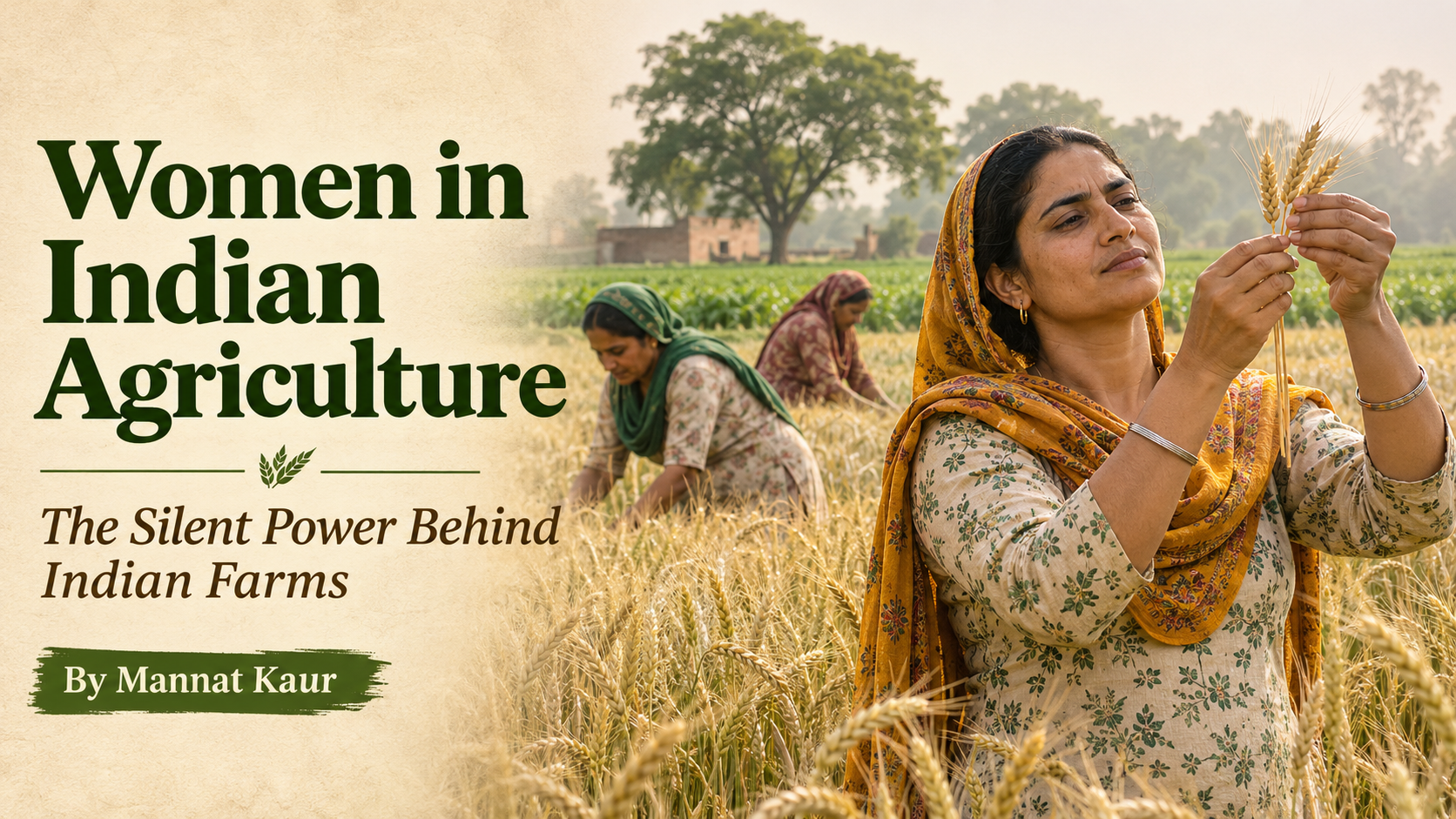
When we talk about Indian agriculture, the spotlight is often on men- ploughing the fields, selling produce in the market or making policy decisions. Yet, in the background, there exists a quiet force that sustains the backbone of Indian farming: women. From planting to harvesting, from feeding cattle to preserving seeds, women contribute significantly at every stage of agricultural production. They are the silent power behind Indian farms, working with dedication but receiving little recognition.
According to various estimates, women constitute over 60-80% of the agricultural labour force in India. They handle multiple responsibilities-sowing, weeding, irrigation, post-harvest processing, storage and even marketing in some regions. In addition, they manage household duties, child care, and often bear the emotional load of the family’s financial uncertainty, especially in small and marginal farming households.
Despite their substantial contribution, women are often excluded from ownership of land and decision-making. Only around 13% of land in India is owned by women, which limits their access to institutional credit, government schemes and modern agricultural technologies. This invisibility in the legal and economic framework is one of the major hurdles in empowering women farmers.
Still, across the country, women are rising above these challenges and setting inspiring examples. In Rajasthan, Kamla Devi transformed a barren land into an organic farm, training other women and forming a cooperative. Take the case of Sukhwinder Kaur, a farmer from Sangrur district in Punjab. When her husband passed away, she took full responsibility for her 4-acre farm. From managing soil health to negotiating, she not only sustained her family but inspired other women to step forward. Today, she conducts workshops to train rural women in organic farming and dairy management.
Recognizing the need to support women farmers, the Indian government launched the Mahila Kisan Sashaktikaran Pariyojana (MKSP) under the National Rural Livelihood Mission (NRLM). It aims to build the capacities of women farmers and promote sustainable agriculture. But schemes alone are not enough. There is a need for greater awareness, legal reforms, and most importantly, a shift in mindset that recognizes women as farmers, not just helpers.
Women’s involvement in self-help groups (SHGs), dairy cooperatives, and organic farming collectives has shown that when given the right platform, they can transform agriculture into a more inclusive and profitable sector. Their financial contributions also lead to better outcomes in child nutrition, education, and household stability.
In conclusion, Indian agriculture cannot progress unless the role of women is acknowledged and empowered. They are not just the helping hands but the driving force behind farms-working silently, consistently, and resiliently. From Punjab’s wheat fields to Kerala’s paddy terraces, it’s time we recognize the silent power of women in agriculture and ensure they are no longer invisible stakeholders, but proud, rightful leaders in farming’s future.
By Mannat Kaur
Contact no -7973833099